Prints & albums · sizes and crops
Portrait print sizes, from wallets to 20x24
Most cameras make pictures in a 2:3 shape. Many of the classic portrait sizes are squarer than that, so ordering an 8x10 or a 16x20 means losing part of the picture. I plan for this while I am still shooting, and I explain it to every family at the ordering stage, because it is the most common surprise when prints arrive.
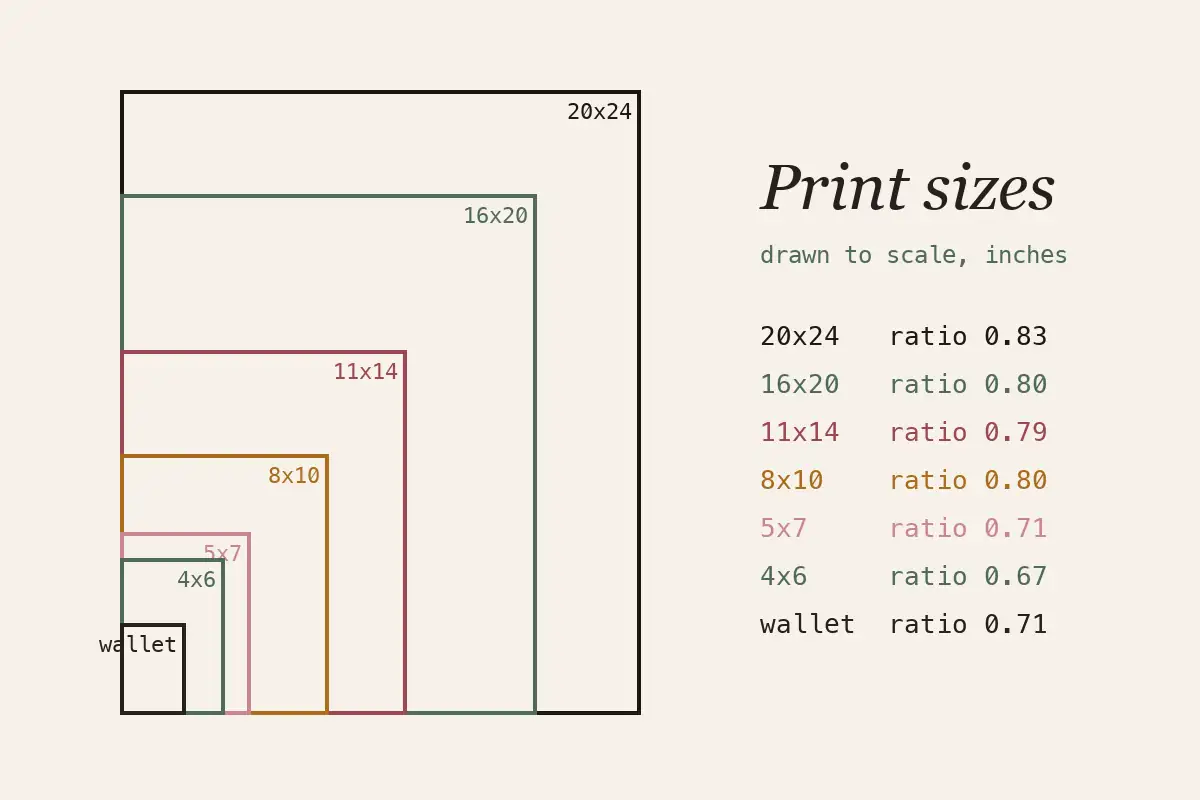
Frame 01The standard sizes at a glance
US portrait labs sell much the same list of sizes, and only three of them match the shape of a camera frame exactly.
| Name | Inches | Shape | What happens to a camera frame |
|---|---|---|---|
| Wallet | 2.5 x 3.5 | 5:7 | Small crop off the long side; usually sold in sheets of four |
| 4x6 | 4 x 6 | 2:3 | Matches the full camera frame, nothing lost |
| 5x7 | 5 x 7 | 5:7 | Trims a little from the long ends |
| 8x10 | 8 x 10 | 4:5 | Noticeable crop; keep heads away from the frame edge |
| 8x12 | 8 x 12 | 2:3 | Full frame at a larger size |
| 11x14 | 11 x 14 | 11:14 | Close to 8x10 in shape, so a similar crop |
| 12x18 | 12 x 18 | 2:3 | Full frame; good for groups and wide scenes |
| 16x20 | 16 x 20 | 4:5 | Same crop as 8x10, now at wall size |
| 20x24 | 20 x 24 | 5:6 | Squarest of the standard sizes; the heaviest crop |
Frame 02Why some sizes cut off part of the picture
A frame from a typical camera is one and a half times as long as it is wide. An 8x10 is only one and a quarter times as long, so to fill it the lab has to trim about a sixth of the long side. On a portrait taken close, that can mean the top of a head or a pair of feet. I leave extra room around the subject for exactly this reason, especially in newborn and family groups where someone is always near the edge.
How much each size trims
- 5x7 and wallets: about 7 percent of the long side.
- 11x14: about 15 percent.
- 8x10 and 16x20: about 17 percent, roughly a sixth.
- 20x24: about 20 percent, a fifth.
When you order, most online galleries show a crop box. Drag it so the trim falls on empty background. If the crop takes away something you care about, choose a 2:3 size such as 8x12 or 12x18 instead. A vertical portrait cropped to 8x10 loses from the top and bottom; a horizontal one loses from the sides, which is where the cousin at the end of the row usually stands.
Frame 03Matching the size to the place
How big a print should be depends mostly on how far away people will stand when they look at it. The farther back people stand, the bigger the print has to be before the faces read clearly, so I start with the spot and work back to a size.
| Where it hangs or sits | Typical distance | Sizes that work |
|---|---|---|
| Wallet, purse, desk | Arm's length | Wallet, 4x6, 5x7 |
| Side table, shelf | 2 to 4 feet | 5x7, 8x10 |
| Hallway, child's room | 3 to 5 feet | 8x10, 11x14 |
| Over a sofa or mantel | 6 to 10 feet | 16x20, 20x24 or larger |
Wallets go in purses and grandparents' frames, and the same images work on cards and small keepsakes. A rough rule for wall pieces: the print should cover about two thirds of the width of the furniture beneath it. A small print over a long sofa looks lost. Large pieces are often printed on canvas, which is covered in wall portraits and gallery wrapped canvas.
Frame 04How big can a file be printed?
Labs like around 300 pixels per inch for small prints that are looked at in the hand. Wall prints are seen from farther away and need less, often 150 to 200 pixels per inch. To work out the limit, divide the pixel dimensions of the file by the ppi you want.
| File (pixels) | At 300 ppi | At 150 to 200 ppi |
|---|---|---|
| 6000 x 4000 (24 MP camera) | about 20 x 13 in | about 30 x 20 to 40 x 26 in |
| 4032 x 3024 (12 MP phone) | about 13 x 10 in | about 20 x 15 to 27 x 20 in |
| 1080 px wide (social media copy) | under 4 in wide | about 5 to 7 in wide |
A file from any recent camera will print a sharp 16x20. The trouble starts with heavy crops, phone screenshots and files compressed for social media. Ask your photographer for full-resolution files if you plan to print large, and read how print and file pricing works before you decide whether to buy files or prints. Keep the originals somewhere safe too; a simple backup routine means you can reprint in twenty years.
Frame 05Paper finishes compared
The same picture looks different on different papers. For most portraits I lean toward lustre, and I use the others when the picture asks for it.
| Finish | Looks like | Best for |
|---|---|---|
| Lustre | Soft sheen, fine texture, hides fingerprints | Everyday portraits, prints that get handled |
| Matte | No glare, gentler contrast | Prints behind glass, soft newborn and maternity images |
| Metallic | Pearly shine, very bright colors | Bold, high-contrast images; less flattering on skin |
| Fine-art cotton rag | Thick, velvety, matte or lightly textured | Heirloom prints and black and white |
For prints meant to last generations, look for acid-free paper and pigment inks, which is what most fine-art cotton rag prints use. Keep any print out of direct sun, because even good inks fade under constant light.
Frame 06Professional lab or drugstore kiosk?
A file that looks right on my calibrated monitor can come back from a drugstore kiosk too dark, too orange or too contrasty. Kiosks often apply automatic corrections and print on whatever paper is loaded that week. Professional labs print to a known color profile, so what I approve on screen is what arrives, and with skin tones and black and white even a slight color cast shows.
If you print files yourself, use a lab that lets you turn off automatic correction, order one small test print before the big one, and look at it in daylight. Prints looking darker than the screen is a very common complaint, since phones and laptops are much brighter than paper. This is also one of the things I would look at when choosing a portrait photographer: ask to see their prints.
Frame 07Planning a set of prints
Right after a session it is tempting to order one of everything. A simpler plan is one large portrait for the main room, a few 5x7s for relatives and a set of wallets. Black and white prints mix well with color on the same wall, and one strong black and white family portrait can tie together a set of smaller color prints. An album or photo book keeps the rest of the session together in order.
- Measure the wall or furniture for the main piece.
- Decide on a 2:3 or a squarer size before you pick the image.
- Choose the image and check the crop box.
- Add small prints for family, then wallets.
- Pick a paper finish for each, with lustre as the safe default.
If your gallery has a deadline, decide on sizes before you open it. The page on viewing and ordering from a proof gallery has a short routine for doing this in one evening, and the prints and albums section covers albums and keepsakes for the images that do not make the wall. Seniors usually want plenty of wallets to trade with friends; my senior portrait notes cover that order.