Family and children · expressions
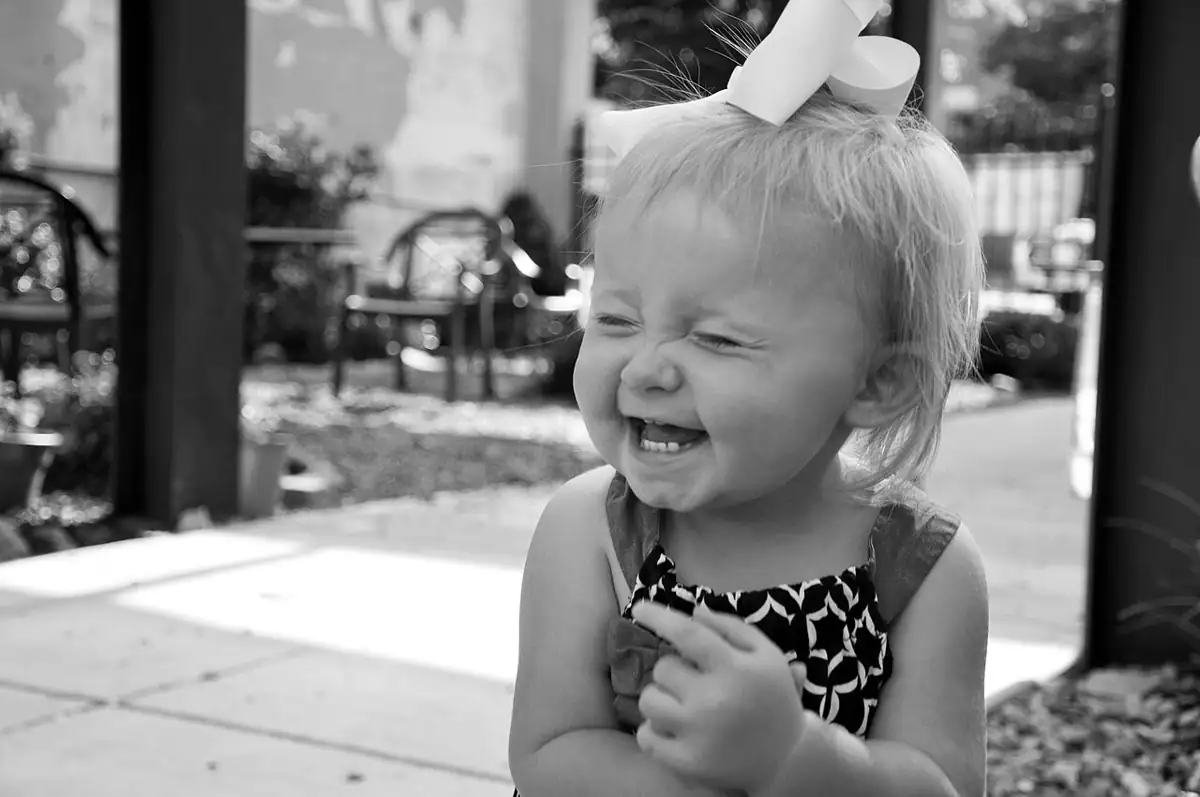
Getting real smiles from children
Ask a child to smile and you will usually get a stiff grin with clenched teeth. The warm, crinkly-eyed laughter parents hope for comes from giving the child something to actually laugh at. I have a relaxed, slightly silly way of working, and with children that is half the job. Every session I do mixes natural, unposed moments with a few posed portraits, and the unposed half is where most of the real smiles turn up. These are the games and habits I rely on, sorted by age, plus what parents can do to help.
Frame 01Why cheese backfires
When children are told to smile, they perform one. The result is a fixed grin that never reaches the eyes. A real smile lifts the cheeks and narrows the eyes, and children cannot fake that on request any better than adults can. Repeating the request makes it worse, because the child senses the adults are tense. I almost never ask a child to smile directly. I give them a reason for one and wait with the camera ready.
Many children have also learned a "photo face" from years of phones pointed at them: chin down, teeth showing, eyes wide. It takes a few minutes of play before that habit drops away, so I never judge a session by the first frames.
Frame 02Warming up before the camera comes out
A stranger with a big camera is a lot for a small child. I start every session with a few minutes of just talking and playing, at their eye level, often with the camera hanging at my side.
- Say hello to the child before the parents, kneeling down to their height.
- Ask about something they are wearing or holding: a favorite shoe, a toy, a hair clip.
- Let them look at the camera, press the button, see a picture of mom on the screen.
- Start with an easy game while the camera is still lowered.
- Begin shooting while the game continues, without announcing it.
By the time the child notices the photos have started, they are usually too busy playing to stiffen up.
Frame 03Games that work
- Peekaboo for babies and young toddlers, from behind the camera.
- Don't laugh: tell an older child they are absolutely not allowed to smile. Most crack within seconds.
- Wrong names: I confidently call mom by a silly name or insist the dog is a cat.
- The whisper game: a parent whispers something funny in the child's ear.
- A race: run to a tree and back, then photograph the breathless giggles.
- Sneeze on cue: I pretend to sneeze every time the child blinks, and the sneezes get bigger.
Toddlers respond best to physical play, like being lifted, swung or tickled by a parent. The toddler photography tips explain how to time this around naps.
What tends to work at each age
| Age | Try | Skip |
|---|---|---|
| Under 1 | Peekaboo, a parent's voice, gentle tickles | Loud noises, strangers' faces too close |
| 1 to 3 | Bubbles, chasing, being swung | Long instructions, sitting still for long |
| 4 to 7 | Silly names, don't-laugh, make-believe | Baby games, which they find insulting |
| 8 to 12 | Jokes, competitions, being in charge | Anything that feels babyish |
| Teens | Real conversation, music, their own ideas | Forced cheerfulness |
For babies who are simply unhappy, no game will help until the basics are sorted. My page on settling a fussy baby during a shoot covers feeding, warmth and pacing.
Frame 04Make-believe and dress-up
Imaginative play gives children something to do besides pose. A child dressed as a princess, a pirate or a superhero tends to act the part, and the expressions follow. Simple props help: a toy crown, a cape made from a blanket, a cardboard boat. Ask the child to show you how a lion roars or how a fairy flies. Years later, these are often the frames that show what the child was like at that age.
When I took part in a blog carousel with other photographers where the theme was make-believe, I went back through pictures of my own boys at play, and those were the images that made me realize how fast the pretend-play years go. They are far from my most polished work, and they are some of the pictures I treasure most.
Do a few minutes of dress-up at the end of a session, after the classic frames. Children often refuse to take a costume off once it is on.
Frame 05The parent's part
Parents are usually the funniest people in the room to their own child. Standing just behind me and making a silly face, dancing, or pretending to fall over works better than anything a stranger can do. What does not help is narrating: "look at the camera, smile, no, a real smile".
Instead of saying
"Smile!" "Look at the camera." "Stop that." "Do it properly this time."
Try
"Is there a frog on my head?" "Whisper your favorite food to your brother." "Show me your grumpiest face." Then laugh at the answer.
Grandparents can be wonderful helpers too, especially with very young grandchildren, but one funny adult at a time works best. Five relatives calling from five directions just confuses a child. There is more on organizing bigger groups on my page about portraits with grandparents and cousins.
Frame 06Older children and teens
From about eight onward, children see through silly games aimed at little kids, and they hate being managed. What works with them is respect and a bit of competition. I ask their opinion on the location, challenge them to make a sibling laugh first, or ask about the thing they care about most at the moment. Teens often give their best expression a second after they think the picture is taken, so I keep shooting as I "finish". A session with just mom and daughter can also take the pressure off a self-conscious teenager, because there is no audience of siblings.
Frame 07Catching the laugh with the camera
A real laugh lasts a second or two, and the best frame is often just after the peak, when the eyes are still crinkled and the mouth has relaxed. If you are photographing your own children, a few habits make a big difference to how many of those you catch. Keep the camera up and your finger ready while the game is going on, instead of lowering it to joke and raising it again. Use a short burst. Set a shutter speed of 1/500 s or faster, because laughing children throw their heads back and move their hands. Focus on the nearest eye and let the background fall soft so nothing competes with the face.
I also keep talking while I shoot. A photographer who goes silent behind the camera makes children wonder what is wrong, while a running commentary of nonsense keeps their attention on me, and their faces stay relaxed.
Frame 08Serious faces count too
Not every good portrait is a laughing one. A thoughtful look, a child absorbed in a flower or a book, or a shy glance up at a parent often tells you more about who they are, and a good gallery has some of each. Quiet expressions also tend to look beautiful in black and white, where nothing distracts from the face. Siblings often produce both in one frame; see sibling sessions.
Frame 09Light and setting help
Children squint and frown in harsh sun, which kills expressions before any game begins. Soft light in open shade or near sunset keeps faces relaxed. The page on photographing people in natural light covers this. Animals help as well: a family dog is often the fastest route to a real giggle, and I have notes on including pets in the session. For seasonal sessions with a playful theme, the holiday portrait ideas include a few costume frames, and every family guide is listed on the section page.