Craft · travel
Travel photography in Sweden and Iceland
Sweden is my home country. I grew up in Säter, a small town in southern Dalarna about two and a half hours north of Stockholm, and lived there until my early twenties, so every trip back is part homecoming and part photo assignment. In the autumn of 2013 I traveled through Iceland, Sweden, Norway and Denmark on a commercial travel shoot for LSU Academic Programs Abroad, photographing the places a planned tour would visit. Iceland had been on my wish list for years, and it was like nothing I had seen before. For a photographer used to the Gulf South, the far north comes as a shock. The sun barely sets in June and barely rises in December, and the land is mostly rock, water and moss. These are my notes on the light and weather up there, the places I keep returning to, and getting your own people into the pictures along with the scenery.
Frame 01Light through the year
Light is the main reason photographers love the north. In midsummer, places above the Arctic Circle, such as Abisko and Kiruna in Swedish Lapland, have the midnight sun, when the sun stays above the horizon all night. Farther south, in Stockholm or Reykjavik, the sun dips below the horizon for a few hours but the sky never gets fully dark. Golden light can last for hours, which takes the pressure off timing.
Winter is the opposite. Around the December solstice Reykjavik gets only about four hours of daylight, and the sun stays so low that every hour feels like golden hour. That long darkness is also the season for the northern lights, which need a dark, clear sky away from town lights.
| Around | Stockholm | Reykjavik | What it means for photos |
|---|---|---|---|
| June 21 | about 18.5 h | about 21 h | Endless soft evening light, short nights, no aurora |
| Equinoxes (March, September) | about 12 h | about 12 h | Normal days, quick changes week to week |
| Early November | about 8.5 h | about 8 h | Low sun all day, first snow possible, aurora season |
| December 21 | about 6 h | about 4 h | Sunrise to sunset is one long golden hour |
Daylight figures are sunrise to sunset for 2026 from timeanddate.com's Reykjavik sun tables and the matching Stockholm tables, rounded. Twilight adds usable blue light at both ends, and in Dalarna, a little north of Stockholm, the winter days are slightly shorter still.
Frame 02Sweden: red cottages and archipelagos
The classic Swedish image is a red wooden cottage with white trim beside a lake or meadow. The red is traditionally Falu red, a paint originally made from copper mine waste in Falun, which is not far from where I grew up. It stands out against green summer grass and even more against snow. Dalarna is a very traditional region, home of the little red Dala horses, and a lovely place to see a midsummer celebration with flower crowns and maypoles in late June. Ask before photographing people at private celebrations, as you would anywhere.
Autumn in Dalarna
I usually go home in summer, so seeing my hometown in autumn, with school and everyday life in full swing, was a treat. I traveled up by train from Arlanda, the main Stockholm airport, and Swedish trains made it easy to get around with a camera bag. While I was there the first snow of the season fell. It only lasted a few days, but the frost and ice stayed on the trees well into the middle of the day, which gave me landscapes in soft, cold light that I never get at home. A friend who farms sheep had newborn lambs that week, and I'll admit those were the most cooperative newborns I've ever photographed.
Stockholm
Stockholm's old town, Gamla stan, has cobblestones, buildings from the early 1700s and lanes that are only about a meter wide in places. The colored merchant houses around Stortorget, the old main square, are one of the city's best known views, and the narrow lanes suit street photography in soft morning or evening light, before or after the crowds. We also took the boat out to Drottningholm Palace, where the royal family lives, on a clear autumn day with the trees changing color along the shore, and came back past City Hall. The archipelago east of the city has thousands of islands, granite shores and boats, best reached by ferry.
Frame 03The Vasa Museum and other interiors
For me the Vasa Museum was the high point in Stockholm. The warship Vasa sank in Stockholm harbor on August 10, 1628, minutes after setting sail for the first time, and was raised in 1961. The museum built around her was inaugurated in 1990, and the ship is enormous up close, carved and dark with age. The museum's own account of the salvage is worth reading before you go.
Museum halls with old wood and protected artifacts tend to be dimly lit, which is hard on a camera. My approach for interiors like this:
- Check the museum's photo rules at the entrance, and leave the flash off; it flattens the wood anyway.
- Raise ISO to 3200 or 6400 rather than shooting at a shaky 1/15 second.
- Use your widest aperture and brace against a railing or pillar.
- Shoot the whole ship from the upper levels, then go close for carvings and textures.
- Keep verticals straight; tall masts and walls lean fast with a wide lens.
The straight-lines habits come from my commercial work, and I explain them properly in my notes on shooting buildings and interiors.
Frame 04Iceland: waterfalls, black sand and weather
We started in Reykjavik at Hallgrímskirkja, the tall white church, and the statue of Leifur Eiríksson in front of it at sunset. The next day, barely outside the city, we were already stopping for Icelandic horses by the road. From there it was Þingvellir, the site of Iceland's ancient parliament, then the geyser Strokkur, which erupted every few minutes while we stood freezing and waiting for the next one, and Gullfoss, a huge waterfall dropping into the canyon of the Hvítá river.
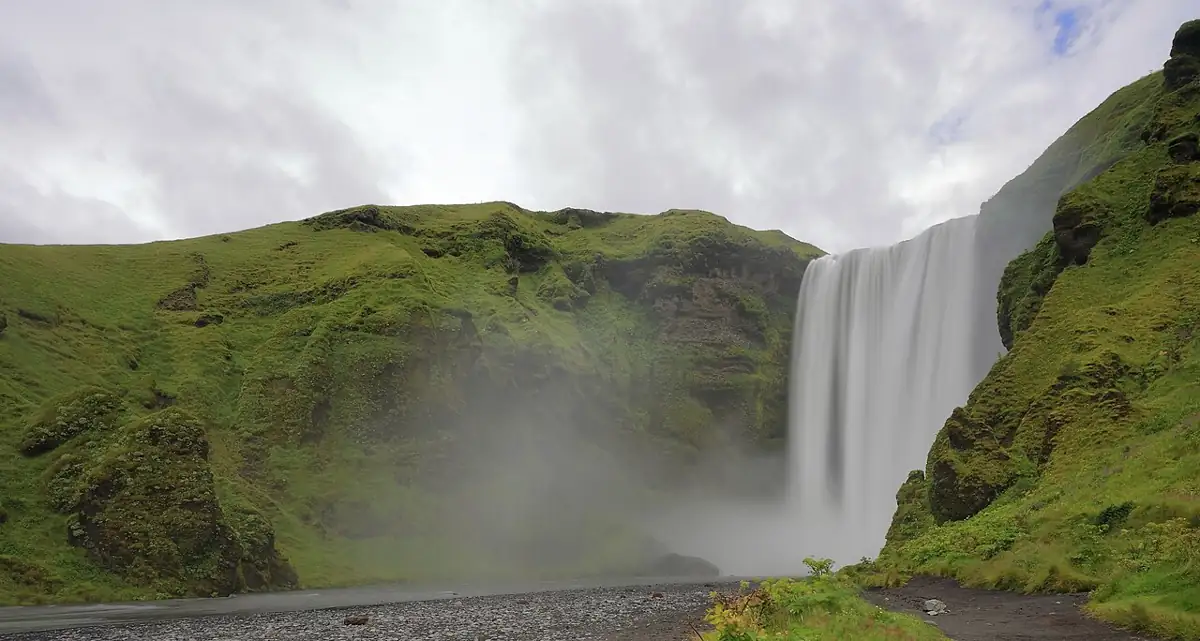
Iceland's south coast is famous for waterfalls such as Seljalandsfoss, which you can walk behind, and Skógafoss, a broad curtain of water with spray that drifts far across the field. Black sand beaches and basalt columns give strong graphic shapes. We came across Dyrhólaey almost by accident: a black lava beach with a huge natural rock arch, which in the warmer months is full of seabirds. Inland, lava fields covered in thick moss look soft from a distance; the moss is fragile and takes decades to recover, so stay on the paths.
The weather changes fast. A rain cover for the camera, a microfiber cloth for spray and waterproof boots matter more than any lens. Wind can be strong enough to topple a tripod, so hang your bag from the center column for weight. At the beaches, watch for sneaker waves, which run much farther up the sand than the others. And our trip ended in the Blue Lagoon, warm water and snow in the air at the same time, which I recommend whether or not you bring a camera.
Seeing the aurora was one of my dreams as a photographer, and in early November we hoped for it several nights but saw it only once, so give yourself as many nights as you can, watch the aurora and cloud forecasts, and get away from town lights. Starting points: a tripod, a wide lens at its widest aperture, ISO 1600 to 3200, exposures of about 5 to 15 seconds, manual focus set on a bright star, and gloves you can work the buttons in.
Frame 05Gear for the trip
- A wide zoom for landscapes and a short telephoto for details and people
- A sturdy travel tripod for waterfalls, interiors and the aurora
- More batteries than you think, since cold drains them; keep spares in an inside pocket
- A neutral density filter if you want silky long exposures of water in daylight
- A macro lens or close-up filter if you love frost and moss as much as I do
Frost crystals on a branch and the moss on a lava field are made for close-up work, which I cover in getting started with macro. Packing, battery rules and security are covered in flying with photography equipment. Gray Icelandic days that look flat in color can be wonderful in monochrome; see when to convert to black and white.
Frame 06Family pictures on the road
Most trip galleries end up full of landscapes and short on family. Make a point of putting your own people in the scene: a child in a yellow raincoat in front of a red barn, a partner watching the falls. A longer lens lets you photograph them naturally while they look at the view, and the soft northern light flatters faces, as described in soft natural light for portraits.
When you get home, a photo book is a good way to tell the story of a trip; see albums and photo books. One big landscape print can carry a whole journey on a wall, and my notes on canvas and wall prints cover sizes and finishes. For wildlife on the way, including puffins in Icelandic summer, the tips in photographing wild birds apply. More travel and technique notes sit in the other camera guides.