Locations · oaks and old houses
Live oaks and historic grounds for portraits
A row of old live oaks hung with Spanish moss is the image many people have of South Louisiana, and it is still one of my favorite places to put a family. The light under the branches is soft and slightly green, and the trunks frame people without any help from me. Oaks also bring roots to trip on and mosquitoes at dusk, and many of the famous ones stand on old house grounds with a painful history that deserves respect.
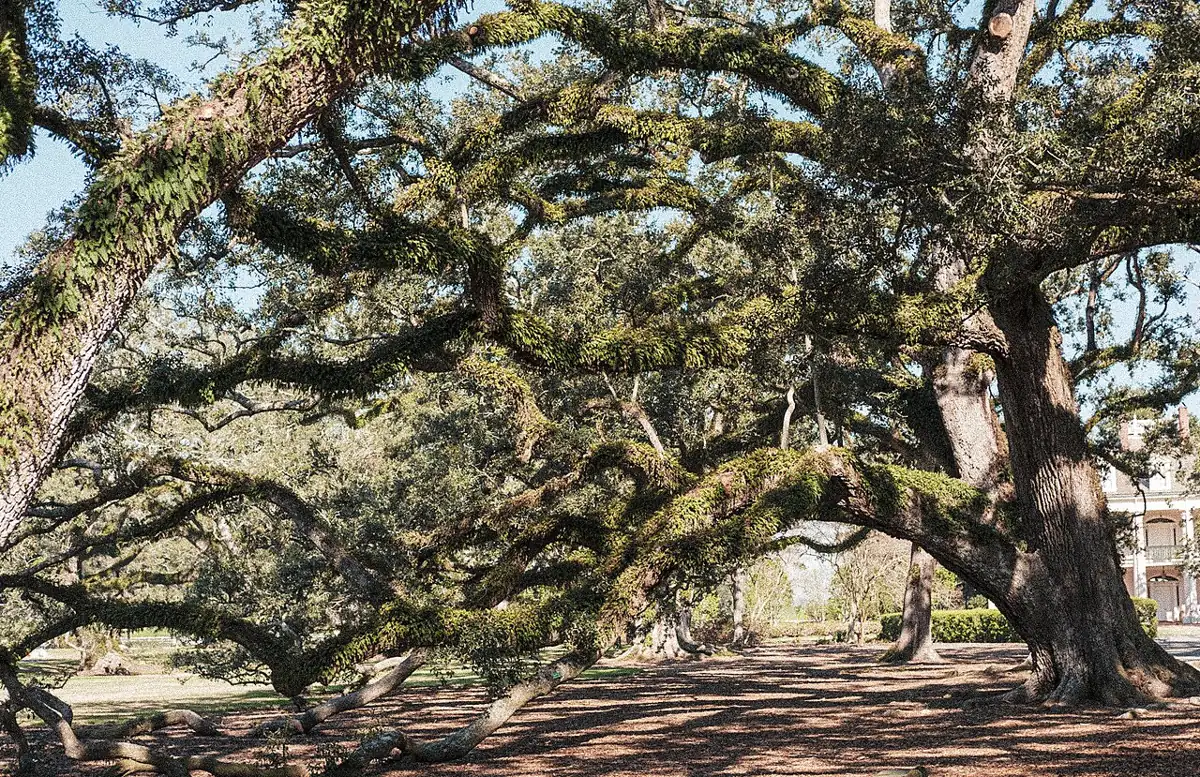
Frame 01Why I keep coming back to the oaks
When I moved to Baton Rouge in the fall of 1998, the live oaks were one of the first things that made me stop and stare. In Dalarna, where I grew up, the trees are birch and pine, tall and narrow. A Louisiana live oak does the opposite. It grows out more than up, with limbs that dip almost to the ground and come back up again, and the Spanish moss hangs off them like old lace. For a portrait that shape works like a room built around the family.
I use oaks for every kind of session: families, children, high school seniors and, very often, maternity portraits. The setting says South Louisiana without a sign in the frame, and it ages well. A picture under an oak looks right on a wall twenty years later, which is less true of a trendy mural.
Frame 02What the canopy does to light
A mature live oak spreads wide and low, so the shade underneath is deep. On a bright day that shade sits next to patches of hard sun breaking through the leaves. Faces caught in one of those patches turn blotchy, and the camera cannot hold detail in both the sunlit spots and the dark trunk at once.
My fix is to place people at the edge of the canopy, facing out toward open sky. The branches above block light from overhead, the open side lights the face evenly, and the trees still fill the background. I check the eyes: bright, round catchlights mean the open sky is lighting the face. Early morning and the last hour before sunset are easier still, because the sun is low and the contrast drops. The broader method is laid out in reading natural light for portraits.
Green light on skin
Under a thick canopy the light bounces off leaves and grass before it reaches a face, and skin can pick up a slight green cast. I check it on the back of the camera and correct white balance later, but it helps to stand people where some light comes from open sky or a pale path. A light-colored dress or shirt also bounces a little warmth back up into the face.
Starting camera settings
For hobbyists, here is where I would begin under oaks, adjusting from there:
| Situation | Aperture | Shutter and ISO |
|---|---|---|
| One person, background far behind | f/2.8 to f/4 | 1/250 s or faster, ISO as needed |
| Couple or parent with child | f/4 | 1/250 s, ISO 400 to 1600 in deep shade |
| Family of four or more in two rows | f/5.6 to f/8 | 1/320 s for moving children |
| Last light after sunset | f/2.8 to f/4 | 1/200 s, raise ISO to avoid blur |
Shade under an oak is darker than it looks to the eye, so do not be afraid of a higher ISO. A little grain is easier to live with than a soft, shaken picture of a running toddler.
Frame 03Moss, color and background
Spanish moss photographs as a grey veil. In large amounts it can make an image feel misty and quiet, which suits black and white and soft, muted clothing. Moss and bark have so much texture that oak portraits often convert beautifully to monochrome, a technique I talk about in black and white and selective color. Bright whites near the moss can look harsh, and saturated reds and oranges compete with the greens. Earth tones, cream, dusty blue and soft greens sit well under oaks.
Look for a background with depth: an alley of trees receding, or a lawn opening up behind the family. A longer lens pulls those distant trunks closer and blurs them, which is why I like an 85mm or longer for this kind of work, as explained in which lens suits portraits. A wide lens has its place too, for one frame that shows the whole tree with the family small underneath it.
For clothing I stick to the advice I have given families for years: the face is the focus, so keep it simple, skip stripes and busy patterns, and choose solid colors that sit in one calm palette. The family wardrobe guide goes through palettes in detail.
Frame 04Season by season under the oaks
Live oaks keep their leaves most of the year and shed and regrow them in a short burst in late winter and spring, so the canopy rarely looks bare. What changes from month to month is the heat, the bugs and the ground underneath.
- October to early December is my favorite stretch. The air is drier, the light is lower in the sky for more of the day, and mosquitoes ease off after the first cool fronts.
- January and February are mild most days, with grey spells that give soft, even light. Bring a jacket for the waiting time and leave it off for the photos.
- March and April bring fresh green, azaleas in many yards and parks, and pollen on everything. Leaves dropping in spring can leave yellow litter on the ground, so I look before I place a blanket.
- From May to September it is hot and humid. I only shoot outdoors in the first hour after sunrise or the last hour or so before sunset, and keep it short.
The month-by-month detail, with storm season, is in my page on South Louisiana heat and light.
Frame 05Historic houses and their history
Many of the most photographed oak alleys in the region belong to former plantation houses. Some are now museums that tell the story of the enslaved people who lived and worked there. Others are private homes or event venues. Families choose these grounds for the trees and the architecture, so I always suggest finding out what the place is and how it presents its past before booking.
Be respectful on the grounds. Slave cabins, cemeteries and memorial areas are not backdrops for portraits, and some sites ask visitors not to photograph them for leisure at all. Read what the site publishes about its history and its rules, and follow staff guidance. If a site does not feel right for a celebration, the oaks at the university campus or in public parks give a similar look, and so do the big trees around City Park and the lakes. The full list of Baton Rouge settings has more options, including country fields and old farm buildings.
Frame 06Permits and timing
Most historic sites, gardens and arboretums have a policy on professional photography. Around Baton Rouge, several LSU-run gardens publish theirs online, with an advance booking and a paid session pass for professional portraits. Some sites limit sessions to certain days, and a few do not allow them. Policies change, so ask the site directly when you plan the session and get the answer in writing if you can. Public parks have their own rules too, so check with the operator before a paid session anywhere.
Weekends in spring and fall are busiest, because weddings and events often take over the grounds. A weekday evening is usually calmer, and I have found that staff are friendlier to a small, quick family session than to a big setup with lights and stands.
Frame 07Footing, bugs and comfort
Roots lift the ground under old oaks and the soil stays soft after rain. Flat shoes for the walk, with nicer shoes carried for the photos, save twisted ankles. Mosquitoes are thick near water and in the shade at dusk from spring through fall, so repellent applied well before the session (and away from the clothes being photographed) helps. Fire ant mounds like the sunny edges of lawns, so I look down before anyone sits. Bring water. Heat under a dense canopy is milder than in the open, though the humidity stays high.
Insect repellent, a small towel, a blanket with a waterproof backing for sitting on damp ground, wet wipes for sticky hands and a spare shirt for the smallest child. For a maternity session under the trees I add a lightweight wrap or shawl, because a long dress drags on roots and moss.
Frame 08Working with young children
Toddlers love oak roots and branches low enough to climb. I let them explore for the first few minutes and photograph that, then bring them back for a group frame. Those first unposed minutes are often where my favorite pictures come from, and I like every session to have a mix of real moments and a few posed portraits. Keep children off branches that the site has fenced or asked visitors to avoid. The guide to photographing busy toddlers has more ideas for keeping a session moving.
The same trees suit expecting mothers. A long dress against a dark trunk, with the canopy framing the bump in profile, is one of my favorite maternity frames, and there is more on that in outdoor maternity sessions.