Craft · flash
Portraits with one off-camera light
One flash, a light stand and an umbrella will light a headshot, a family group or a sunset portrait. I've used that kit indoors and out, and it still covers most of what I need when the daylight runs out. What makes it work is getting the flash off the camera: moved even a few feet to the side, it starts to look like window light. Below is the setup I start with, the settings that go with it, and the bit of physics that explains why the light behaves the way it does.
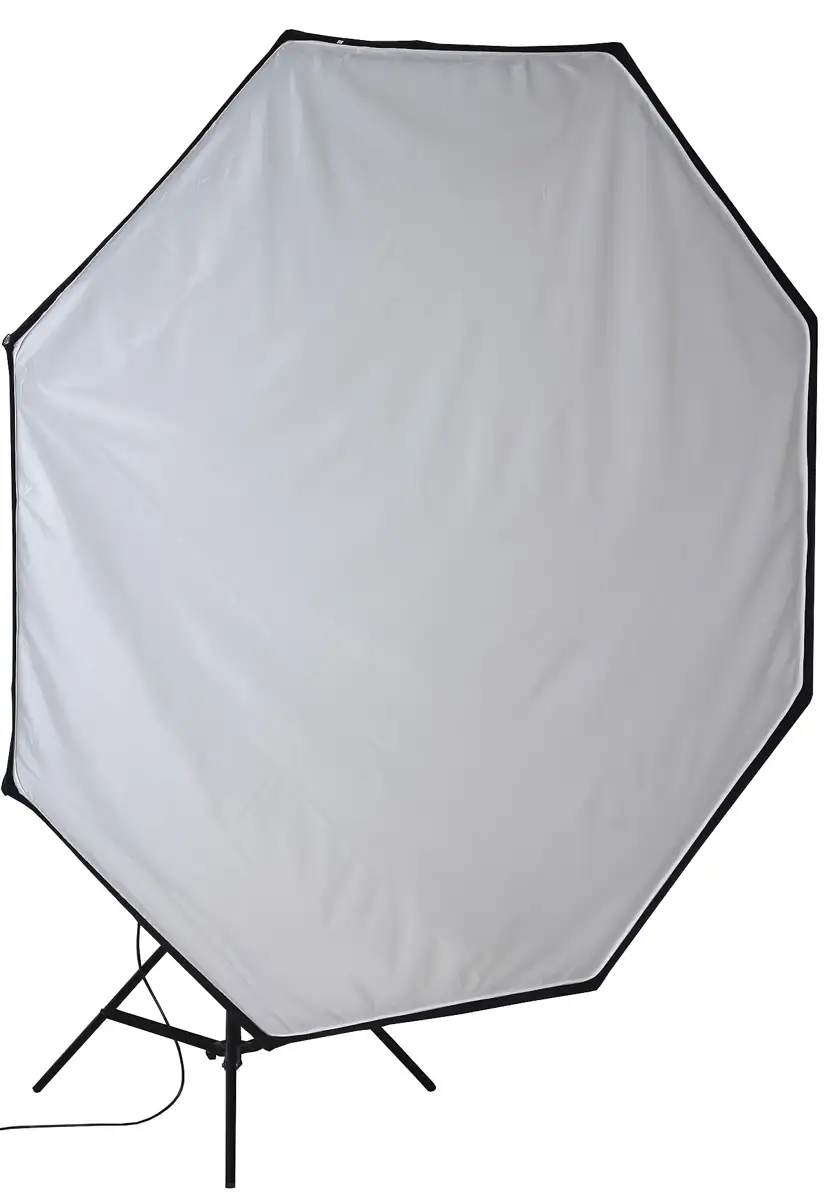
Frame 01Why off the camera
A flash on top of the camera fires straight at the face. Shadows fall directly behind the subject, skin looks flat and shiny, and eyes can glow red. Move the same flash to one side and above eye level and it behaves like a window: one side of the face is lit, the other falls into soft shadow, and the face looks three dimensional. The shadow from the nose now falls down and to the side, which is how faces look in sunlight or by a lamp.
Frame 02What you need
- A speedlight or small battery strobe with manual power control
- A wireless trigger on the camera and a receiver for the flash, or a flash with a built-in radio receiver
- A light stand, ideally one that reaches above head height
- A shoot-through or reflective umbrella, or a small softbox, somewhere around 80 to 110 cm across
- Spare batteries, since a flash used often at higher power drains them quickly
- A sandbag or a bag of gear to hang on the stand outdoors
A white foam board to bounce light into the shadow side is useful but optional. I'd rather someone owned one flash and learned it well than bought three and ended up with flat, over-lit pictures.
Frame 03Placing the light
- Put the light about 45 degrees to one side of the person and a little above their eyes, angled down toward the face. This is the classic loop lighting position: a small shadow from the nose points down toward the corner of the mouth.
- Bring it as close as the frame allows, usually 1 to 2 meters for one person. The closer and larger the light, the softer the shadows.
- Set the camera in manual mode. Choose the aperture you want and a shutter speed at or below your flash sync speed.
- Start the flash at low manual power, around 1/16 or 1/8, take a test frame and adjust power until the face looks right. Each step on the power scale (1/8 to 1/4, say) is one stop.
- Move the light, not the person, to fine tune shadows under the nose and chin. Swing it farther around toward 60 to 90 degrees for drama; bring it closer to the camera axis for flatter, more forgiving light.
For a group, move the light farther back and raise it so it covers everyone evenly. A light that is too close makes the nearest person much brighter than the one on the far side, and the next section explains why.
Frame 04The inverse-square law in plain words
Light from a small source falls off with the square of the distance. Double the distance from flash to face and only a quarter of the light arrives, a loss of two stops. The formula is set out in the inverse-square law article, and it holds best for small sources; a big softbox only starts to follow it closely once you are well back from it.
A light 1 meter from someone who stands 3 meters in front of a wall leaves the wall much darker than the face, so the background drops off nicely without any extra gear. Pull the same light back to 3 meters and the falloff becomes gentle, so the face and wall come out closer in brightness. And for groups, keeping everyone roughly the same distance from the light, by putting it farther away or arranging people in a gentle curve around it, keeps faces even.
Frame 05Umbrella, softbox or bare flash
Umbrella
Cheap, light, quick to set up and spreads light widely. Good for families and groups. Wind catches it easily outdoors, so weigh down the stand.
Softbox
Gives more control over where the light falls and makes neater catchlights in the eyes. Slower to set up and pricier for the same size.
A bare flash gives hard, crisp light with sharp shadows. That can suit a dramatic portrait, but it is unforgiving on skin. Indoors, another free option is to bounce a bare flash off a white wall or ceiling beside the person. The wall becomes the light source, big and soft, though it will pick up the wall's color.
Feathering a softbox
Turn the softbox so its center points just in front of the face rather than straight at it. The edge of the light, which is softer and slightly dimmer, lands on the skin. I do this on almost every headshot because it smooths highlights on foreheads and cheekbones.
Frame 06Camera settings: who controls what
With flash, shutter speed and aperture do two different jobs.
| Control | What it changes | Starting point |
|---|---|---|
| Shutter speed | Ambient light only (up to sync speed) | 1/125 to 1/200 s indoors |
| Aperture | Flash and ambient together | f/4 to f/5.6 for one person |
| Flash power | Flash only | 1/16 to 1/8, then adjust |
| ISO | Flash and ambient together | 100 to 400 |
So if the background looks too dark, slow the shutter to let in more room light. If the face is too bright, lower the flash power or move the light back. I keep the shutter fast enough to avoid ghosting from the room light, generally no slower than about 1/60 for an adult who is standing still.
Frame 07Mixing flash with daylight
Outdoors, flash fixes the problem of a bright background behind a dark face. Put the sun behind your subject, expose the camera for the sky or background you want, then add flash to light the face. The flash only needs to match or slightly lift the face against the ambient light. This works well at sunset, on a riverbank or on a Gulf Coast beach at sunset, and under trees where faces would otherwise be too dark. It pairs naturally with the backlight method in working with daylight.
Most cameras will not sync flash above about 1/200 or 1/250 of a second, because above that speed the shutter curtains never fully expose the sensor at once. In bright sun that forces a small aperture like f/8 or f/11. High speed sync, offered on many flashes, gets around the limit by pulsing the flash, and the cost is power: expect to lose roughly two stops, so the flash has to come closer. A neutral density filter on the lens is the other way out.
Indoors at Christmas, the opposite problem shows up: warm tree lights and lamps against cool, white flash. A slow shutter brings in the glow of the lights, and a warm gel on the flash brings its color closer to the room. I use this for holiday portraits by the tree.
Frame 08Common mistakes
The usual errors are a light too far away, which makes it small and harsh, and a light at face height, which lights the background and flattens features. Too much flash is the third, and it makes the subject look pasted onto the scene. A fourth is forgetting the catchlight: if the light is so high that the eyes show no reflection, lower it a little.
The same single-light setup is all that a clean office headshot needs, as shown in a simple office headshot, and a bounced flash also helps balance windows and room light in interior photography. When the room is too small to back up, a wider lens from the lens comparison helps keep the light out of the frame.
Off-camera flash is rarely appropriate for newborns, who are better photographed by the window; see how newborn sessions run and the comfort and handling guidance in newborn posing safety. Other lighting and lens guides are listed on the photo craft index.